
Testimony Smothering
Rape culture and why survivors struggle to share their stories

I have met a lot of women who want to share their stories of sexual violation but feel stuck behind a wall of silence. I always tell these women that this self-silencing is not a personal failure. It is a reasonable survival response in a violent world.
I want to unpack this a little more because I think it is important to understand in order to unwind the spell of silence survivors of sexual violation specifically experience.
There is a concept in feminists philosophy called testimonial smothering (as opposed to silencing). It describes what happens when a person silences their own story — holds it back, softens it, or swallows it entirely — in anticipation to the people around them being incapable of receiving it. Not just unwilling. Incapable. Unable to hear the truth of what happened without distorting it, minimizing it, turning it back against the teller. Likely they have had numerous experiences that confirm this. These experiences can be re-traumatizing for survivors and so it is reasonable to protect against the pain of not having their testimony well received.
Rape culture does not only produce violence. It produces a system of epistemic silencing — a set of myths, social reflexes, and institutional frameworks that systematically undermine a survivor’s credibility before a single word is spoken. A survivor knows, even if she1 cannot name it, that her story will be filtered through those myths.
That she will be asked why she didn’t scream, why she didn’t leave, why she waited, why she went back. That the question of what happened to her will be treated as a matter for others to adjudicate, often from the position of protecting the abuser (whether there is awareness of this being the underlying motivation or not).
So she smothers the testimony. Not because she doesn’t know what happened, even though she might be experiencing a lot of psychological or emotional complexity. Because she knows exactly what will happen if she speaks and that is too painful to bear.
The word testimony comes from the Latin testimonium, meaning “proof” or “evidence,” derived from testis — meaning witness.
But testis has a second, more charged meaning: testicle.
This is not coincidence. In Roman legal culture, only men could bear witness in court. The same word named both the act of giving credible legal evidence and the male anatomy — because these were understood as the same thing. To testify was, etymologically, something a man did by virtue of being a man. Some scholars trace this further to the practice of swearing oaths by grasping one’s testicles (or another man’s), as a pledge of masculine honour and truth-telling. The body and the credibility were fused.
Words as testimony, in this context, are a precarious vessel for women. We enter a world already shaped against the survivor. This has been my own lived experience and as someone who has mastery over words, more often than not, sharing my own testimony has resulted in communicative failure with the emotional burden falling upon my own shoulders (I am presently in such a situation and writing this is apart of my own practice of pushing against the smothering)
If testimony is etymologically a male act, grounded in a male body, then the epistemic system that produces testimonial smothering is not just culturally biased but linguistically encoded. The very word for “being believed” carries within it the exclusion of women as credible witnesses. Testimonial smothering isn’t an aberration of the system; it may be the system working exactly as it was built to work.
This makes the turn to image as an alternative form of testimony all the more resonant. If the inherited vocabulary of witness-bearing is gendered against women at its etymological root, then stepping outside that vocabulary — into the body, into ceremony, into the visual — is not a retreat from testimony. It is a refusal to testify on terms that were never designed to receive her truth in the first place.
Artemis, notably, operates entirely outside male juridical space. She doesn’t petition to be believed. She simply is, on her own ground, on her own terms. The etymology almost makes the mythology feel inevitable.
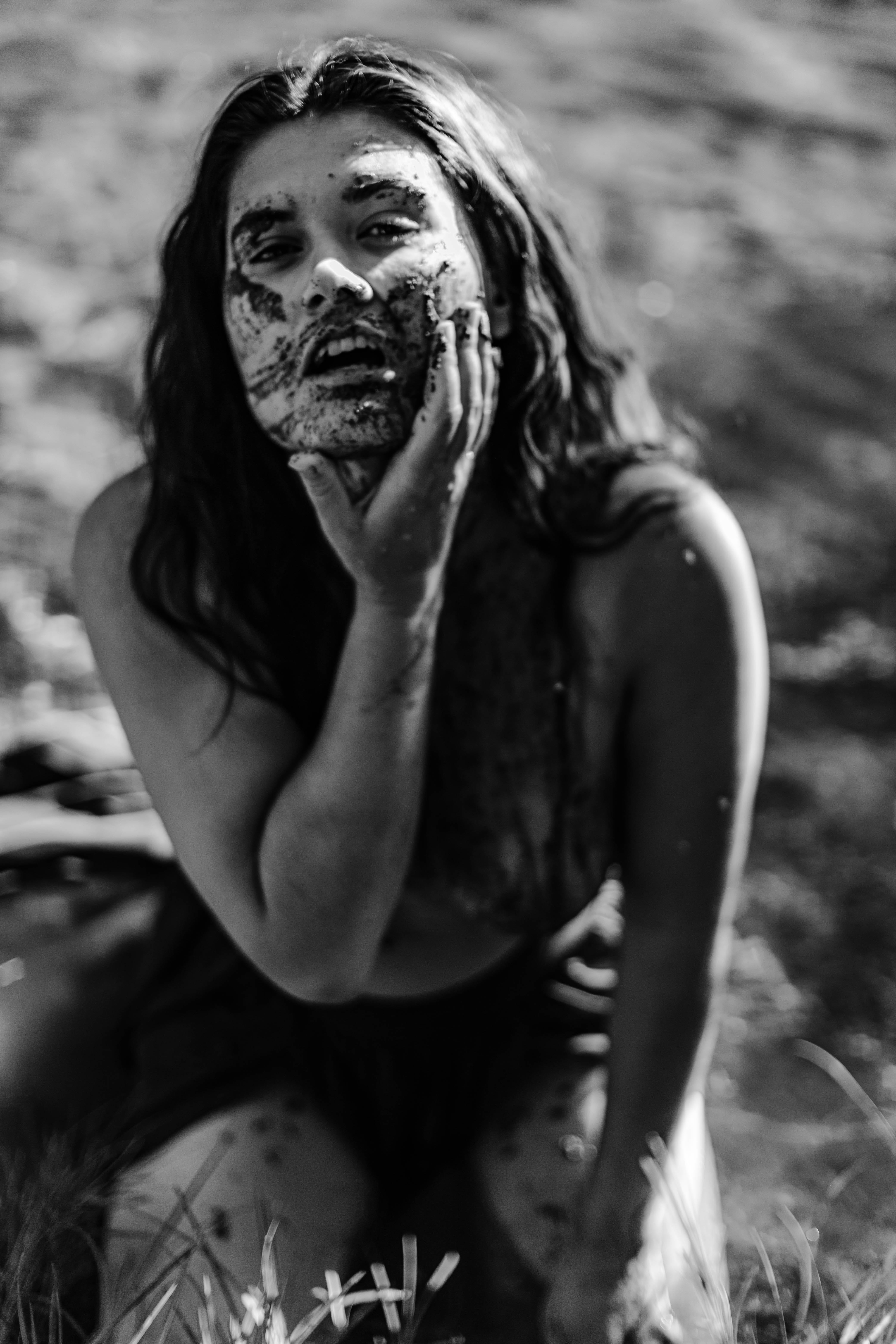
I created the Artemis Project to offer survivors a space to break the spell of smothering silence and reclaim their story through imagery. When a woman steps into a ceremonial photography container, be it on a riverbank, in old forest, on the open land, something moves. She is not asked to narrate her experience in terms the culture has already decided it will or won’t believe. She is asked simply to arrive and be witnessed. This is what so many survivors do not receive.
To bring her body, her grief, her rage, her tenderness through raw embodied presence is a reparative experience. To let what is true in her move through her, and to be witnessed in that truth by a lens held with reverence.
The image that emerges is not testimony in the conventional sense. It is not an official statement that can be cross-examined, doubted, or reframed by someone else’s mythology. It is a somatic, in body, in nature, in culture record of a woman inhabiting herself — sovereign, present, entirely her own after violation. It is evidence of something the culture told her was impossible: that she is still whole. That the wound did not consume her. That her body belongs to her. And that her story matters.
About The Artemis Project
The Artemis Project is a ceremonial photography initiative for women survivors of sexual trauma. It combines somatic preparation, land-based ritual, and mythopoetic embodiment photography to support women in reclaiming what violation steals: not sexuality itself, but sovereignty over it.
Artemis — the goddess of the wild, the untamed protector, the guardian of erotic innocence — is the mythic spirit guide of this work. She is the one who never submitted to male dominion. Who claimed her own body as her own domain. Who carried rage and tenderness in equal measure and never apologized for either. She is, perhaps, the oldest image we have of a woman who refused to let the world define what she was.
In her name, this work asks: What if the image could do what words have been prevented from doing?
What if being seen — truly seen, with care and reverence, on your own terms — could begin to repair what years of being trapped behind a wall of silence? The Artemis Project is not therapy, and it also does not ask you to arrive healed. It asks you to arrive as you are — with everything the wound has left in you — and to let the ceremony with body, land, and goddess— hold all of it.
If you have lived experience of sexual trauma, if you feel a pull toward embodied or expressive approaches to healing, if some part of you is tired of trying to find the right words for something that lives below language — this work may be for you.
Learn more and apply at infinitebodystudio.ca/theartemisproject.
I am intentionally using she/her because women are disproportionately victims of sexual abuse, which is what this essay address. My work is specifically for those who identify as women (including trans and non-binary folks). I understand that those socialized as men also experience sexual violation, and this may be equally validating for their own experience although that is not my own personal experience.