
Wild What the Camera Gave Me
On the lineage of women who laid their bodies bare on the land — and the body of work I am still becoming

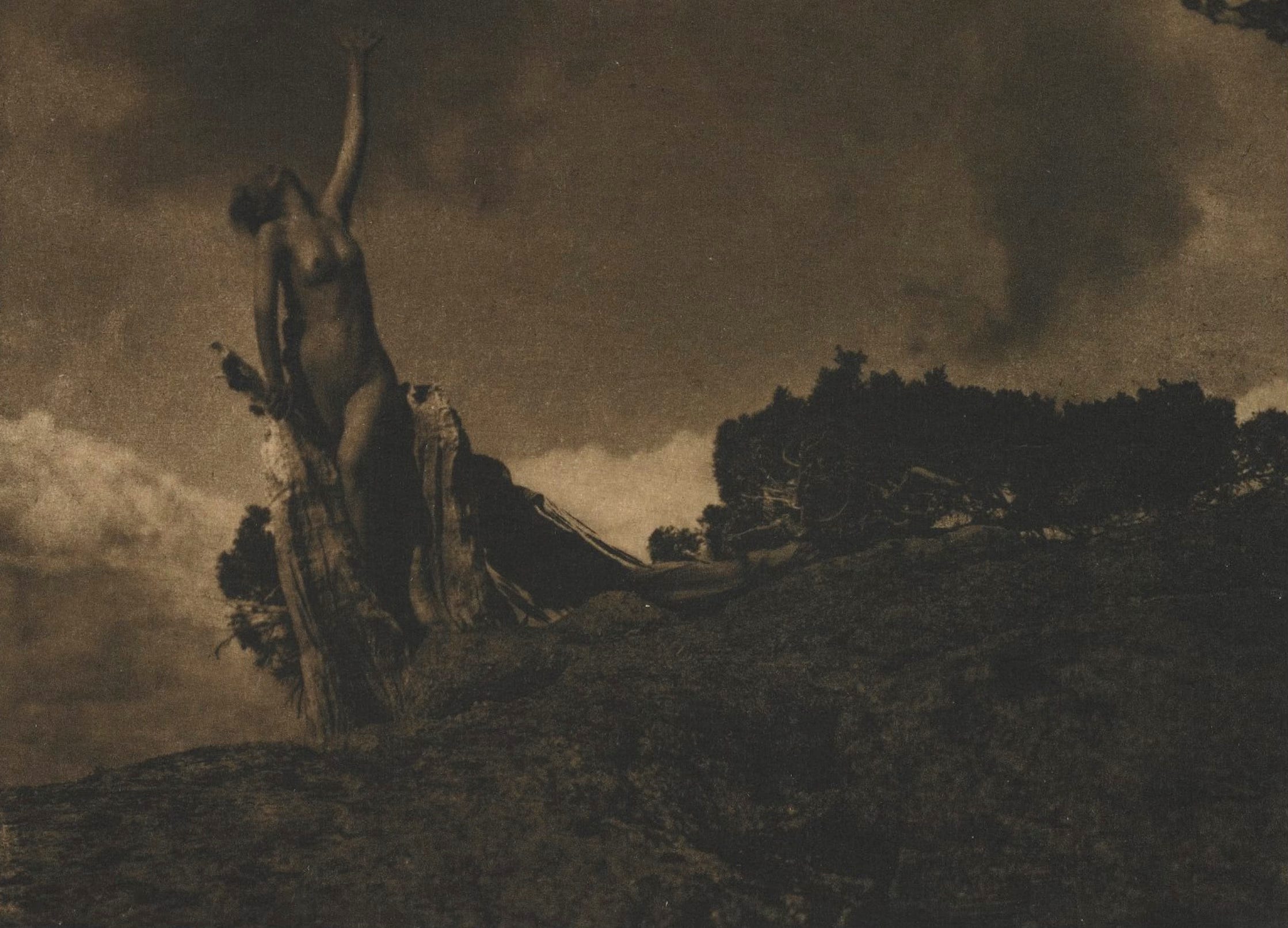
There is a wild image I keep returning to. Not one of mine. One of Anne Brigman’s — made in 1909 near Donner Lake, in the Sierra Nevada. Her nude body occupies the foreground of the image. Behind her: the vast, indifferent mountain. The same mountain that male photographers before her had focused their lenses on to celebrate transcontinental expansion, the triumph of industry, the inexorable westward push of a nation.
Brigman put herself in the foreground instead, calling to attention her alive, undeniable presence. Her imagery is raw, vulnerable and expressive. I imagine that the process of creating this image was deeply healing, embodying, and cathartic and the fact that over 120 years later, it is still being seen by a new generation of women photographers, speaks to the power of such an image.
The creation of this image would have been incredibly deliberate, meaningful and in many ways, slow. Its public presentation required support from influential men who saw her talent and uplifted it. But beyond this, it required a deep commitment to herself as an artist willing to take up space and push back against social norms.
What gives an image such power?
About 3 years ago I went to visit my grandfather. We exchange the typical pleasantries and then he shifts into his authentic approach to our relationship—shaming me until I relent my unacceptable lifestyle and get in line with this patriarchal values.
This isn’t anything new, I have just learned how to navigate it. This time was different. He had recently snooped on my Facebook and saw one of my nude images. I do not know which one it was, but based on his reaction, I am guessing it is one where I am the subject.
He is very upset and I guess feels totally justified to tell me just how ashamed and embarrassed he is. I get upset (more than normal) and leave. My images were pushing against his beliefs and views, which were always being projected onto me.
As upsetting as that experience was, it simply illuminated what I had always felt and I choose to stand in my truth because in my bones I know that the images that I create are apart of my liberation. It did take some time to integration (I won’t say get over it because I am not sure I will ever be over being told that I am a shameful embarrassment by someone who is supposed to love me). But I share this story because it clearly demonstrates why I create images and why Anne Brigman did so as well.
I feel like this power is being stripped from us by the image economy.
Images have always held power in our lives. We are visual creatures. Art is apart of how we make meaning and culture. Corporations know this and have built giant industries around what is an innate creative impulse and need. Visual imagery is one of the most monetizable expressions of human behavior ever discovered. What changed wasn't human nature. Our brains were just as wired for visual processing in 1900 as they are now. What changed was the technology of access.
Let’s just think about our smart phone cameras. This is a $40 billion industry as of 2024 and is expected to grow. Visual social media, which has experienced exponential growth because of the accessibility and quality of smart phone cameras, is an industry valued in the trillions! So with billions of dollars being spent annually specifically to make image capture better, faster, and more accessible, it’s important to understand what is lost in the mix of an entire economic ecosystem (which now includes Ai).
Ok back to Brigman.
I wanted to go and be free. that is all that I wanted.
The ache in my legs for flight … [and] … the wild, wonderful need to stampede.
I didn’t know her work when I first felt the ache in my own legs to run into the wilderness with a camera (back in 2017). I only knew that an impulse to create what I now call the wild image, was burning in my body, too. At first, this impulse felt something between terror and homecoming but I knew it could not be ignored, silenced, or hidden. Not any longer.
The base instinct of a woman coming home to her body has a visual language and Brigman was one of the first women to bring this language to visual form. As a feminist art 70 years before the term would be used, Brigman began to embody an ideology, a value system, a revolutionary strategy, a way of life through which woman could redefine their role in society. I discovered Brigman through Ann Wolfe’s essay Laid Bare in the Landscape, written for the Nevada Museum of Art’s 2018 exhibition on Brigman, and her predecessors.
What I discovered was the traces of a lineage of women photographers who I recognize in my own body of work even though I arrived at it ‘unknowingly’. I am grateful for Wolfe’s words which very clearly speak to my own creative process with nude in nature photography and affirms that I am not alone:
Brigman, and the female artists who followed her, sought freedom by claiming their bodies and the landscape as their own. By the second half of the century, many women artists had discovered that the act of making nude photographs of themselves and other women outdoors forced new and challenging dialogues surrounding definitions of beauty, femininity, vulnerability, ritual, identity, body politics, and environmentalism.
What the camera gives us perhaps can never be fully expressed in words, but our images speak in a language of our own, a language we have full agency and sovereignty over. When I first discovered this language, I did not know that photography would open me up to a terrain so full and untamed and that it would become my vocation. But after nearly a decade, I am taking time to honour the artistic ancestors who came, camera in hand, before me.
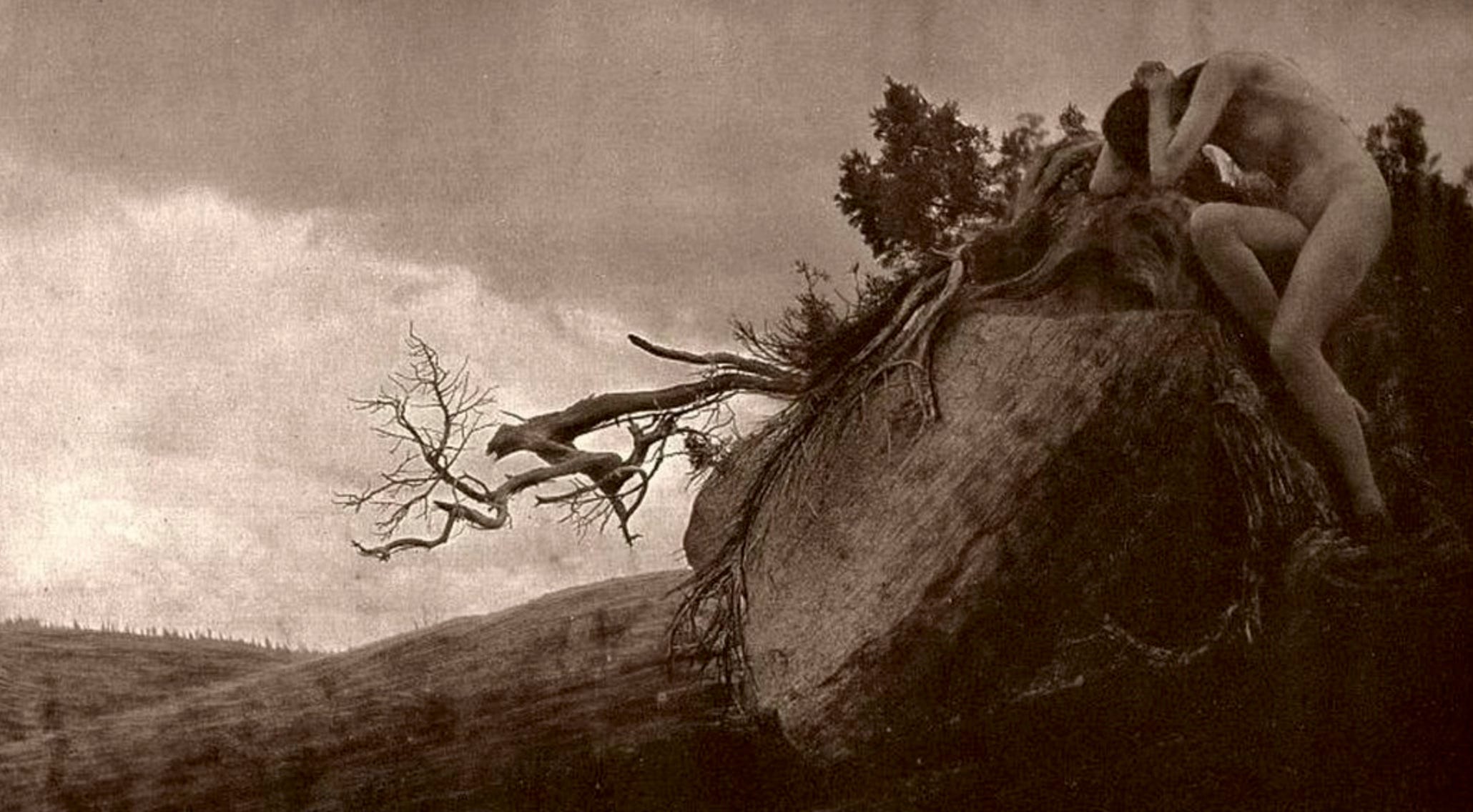
I cannot tell you the relief I felt when I found these images. Through so much of my own grief, fear, resistance, rejection I embraced the often unglamorous work of learning to feel safe in my own skin through visual imagery. Knowing that there is a century of women who brought their bodies to the earth, stripped away the male gaze, and chose the land as their collaborator, their witness, their co-conspirator in self-liberation and healing, has been a gift.
Especially as so much of the poetic power of imagery is being eroded through social media over-use and Ai proliferation in the image market. I really do want to emphasize and uplift what connects us as artists because this is what will weave deeper meaning into our own bodies of work.
What connects all of these women is not nudity. That is too small a word for what they/we were/are doing. What connects them/us is our quest for sovereignty, freedom, and power reclaimed. The insistence within each image is made in the soul first, then the somatic imagination, then the body moving in collaboration with the expressive truth of a woman, with the land, then with the camera. All of which is guided by a rejection of patriarchal culture which views a woman’s body as an object for the taking, for extraction.
The journey of creating nude images, In Brigman’s own words:
You remember, too, the long steep trails that lead zig-zag, mile after mile, away from trees and brooks, up, up into the heat of rocks blessed by the sun, where your lungs ache and your heart hurts from the struggle—and then you find it—the Vision!—the glory of the things beyond. The memory and the wonder of it goes with you to the lowlands, into the daily life, and you are glad that you had the courage.
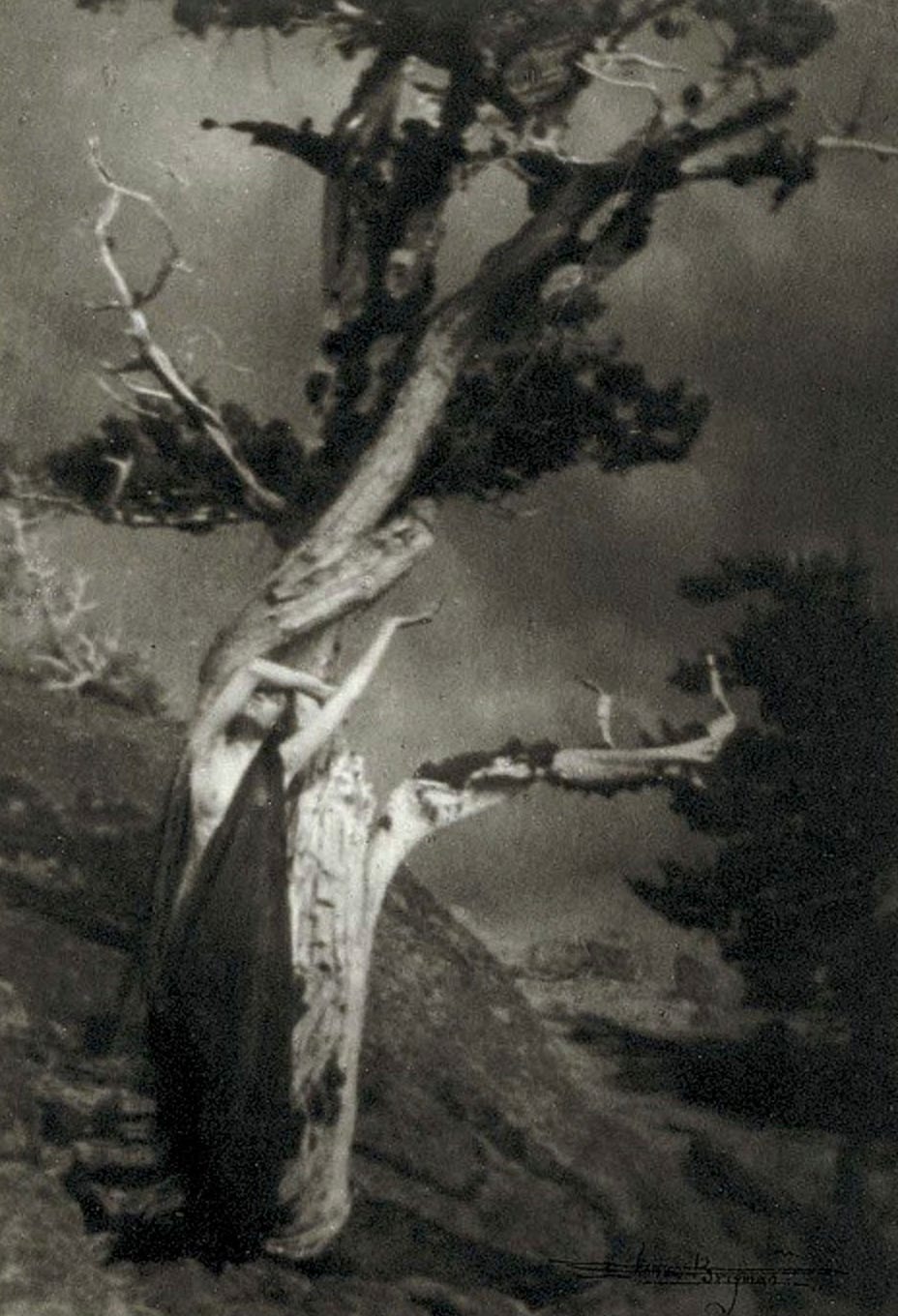
Yes, this requires courage. This isn’t about being seen in the art world because during Brigman's time this was the only avenue for a visual artist, but to reject what lingers in our social conventions around our bodies as women. When we create against the ongoing violence of patriarchal culture, which has long preferred women as objects of vision rather than creators of it within their own creative agency, we experience freedom.
I understand this. I have lived it. I will share more about my journey in future posts but I want to leave a quote that influenced me a lot in the early days of turning the lens towards my own body. I hid in the bushes so no one would see me. I was terrified. I didn’t understand what I was feeling or that I was joining a lineage. I just knew that the act of being seen — by myself, by the land, by the camera’s — was the most frightening and the most necessary thing I had done in years in my entire life. When I returned home and edited the images, a door would open up. These worlds by Clarissa Pinkola Estés speak to that experience:
The doors to the world of the wild Self are few but precious. If you have a deep scar, that is a door, if you have an old, old story, that is a door. If you love the sky and the water so much you almost cannot bear it, that is a door. If you yearn for a deeper life, a full life, a sane life, that is a door.
I still open this door whenever I pick up the camera, with myself or a client. Each new image is a thread in this wider tapestry.
Here are some of my early nude self-portraits


If you are a photographer who wants to weave with this lineage from a professional orientation—Wild Image Practitioner Training may be for you. Wild Image Practitioner Training is a 6 month course for photographers who want to learn how to hold ceremonial embodiment space for their clients. Now open for enrolment.
Jenny is a certified integrative somatic trauma practitioner and the creator of Infinite Body Studio. She has held over two hundred photography ceremonies for women on the Pacific coast of Canada.