
You aren't photogenic
Real wildness has no 'good angles' and can't be captured

I have lost count of how many women have told me in a photography ceremony that they do not feel that they are photogenic. I often joke and say that is because I haven’t photographed them yet. But I don’t actually think this a joking matter so I want to address it as the serious topic that it is.
Plus, whenever there is a rhetorical pattern showing up in my work, I feel an obligation to unpack it.
So lets do that…
Real wildness is not photogenic.
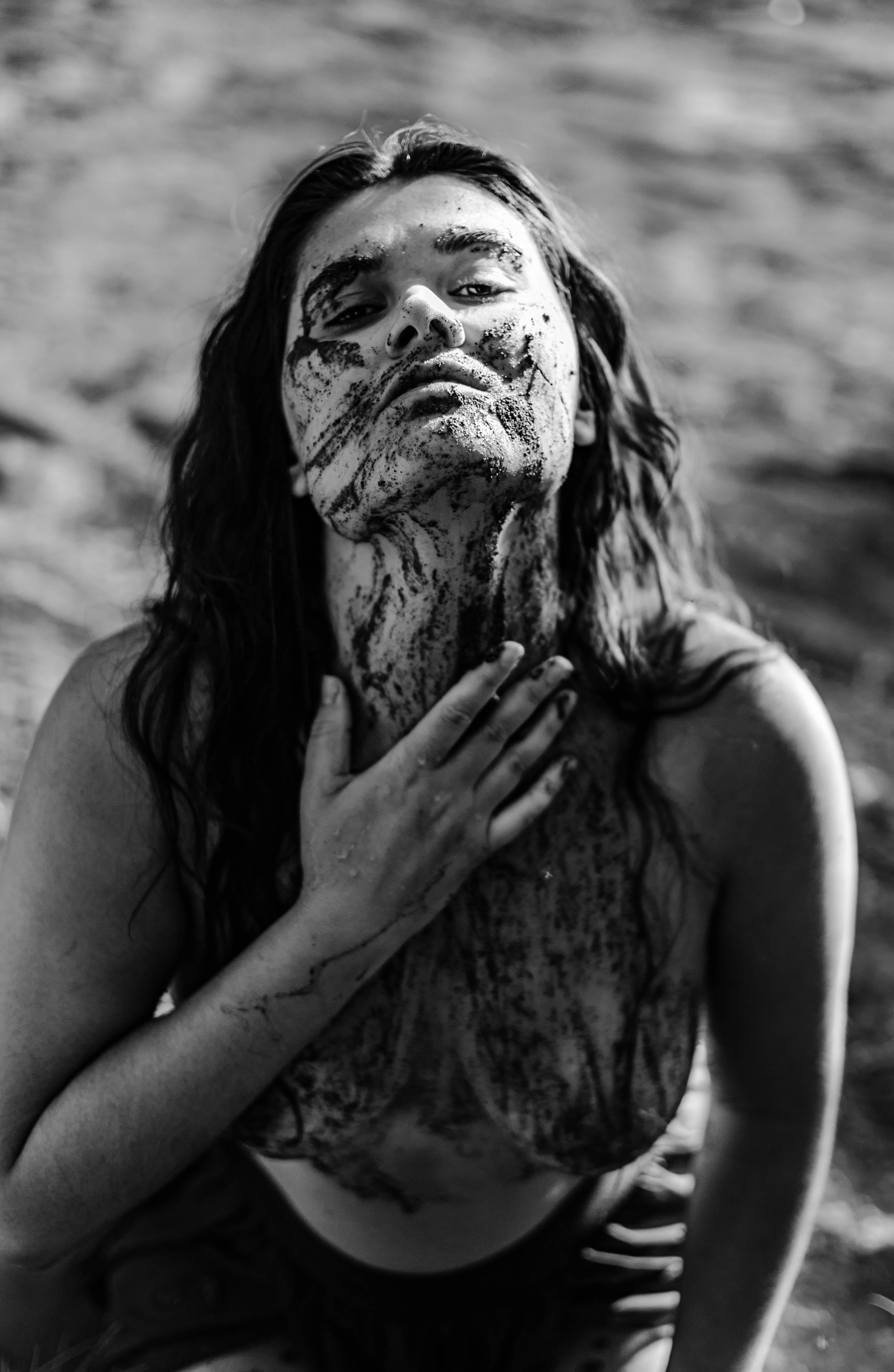
It cannot be captured, even though patriarchal society has tried to capture and contain the wild feminine for generations. But here is the thing—the rage at injustice, the grief that howls in our bellies, the eros that erupts and spills over the edges of ‘acceptability’ are so dynamic and emergent from the depths of our being that the core of that expression cannot be contained in anything other than our bodies.
But what has been contained (or enclosed in the work of Sylvia Federici, is our wild bodies.
The Wild Image is rooted in a commitment to deconstruct the rules around what constitutes photogenic in the first place— aging and decay, the messiness of actual bodies and emotional needs — and fundamentally revealing the parts of ourself that want to crawl into hiding the second a camera appears. The work is to invite the wild body to express herself as herself, for herself.
But let’s look deeper. There is a distinct experience of being looked at in a photographic setting, but this is something that women have been navigating culturally in a very specific way for millennium. We call it being caught in the male gaze, but what is the psychological impact?
Jean-Paul Sartre (who was the partner of feminist Simone De Beauvoir) argues that the moment you become aware of being seen, your psyche splits. Part of you keeps living from the inside — the lived experience of the body-subject — and part of you starts managing an image of yourself as seen from outside (the body-object). ‘Being-of-others’ as Satre called it. What constitutes ‘photogenic’ is determined by the desires, preferences and values of the object viewer (in this context, men) projected onto the body-object, which then becomes internalized.
That is why the most common claim of being un-photogenic is often related to body size because body size has largely become the determining factor of ones experience of “being for other.” In the West, skin=good/desirable, fat= bad/undesirable. The sad reality is that this seems to be implicit body memory because the body has already organized itself as an object that either fits inside of the construct of desirability aka photogenic or outside of it. Photogenic is a body that has pre-digested judgements of being viewed as worthy of being seen in the first place.
This is what is going on underweight our ‘body-image”. Women have a tendency to collude with their own objectification. This reality is not our fault but we do have the power to resist it. So let’s unpack it a little bit more. If this is triggering for you, I invite you to get curious with that activation. So let’s go back to Sartre for a moment, when it comes to being-for-others, he offered the idea of bad faith. When a woman says that she is not photogenic this is what is taking place:
You start treating yourself as though being un-photogenic is apart of your fixed nature. You decide that you are a "type," rather than the open, emergent, and free to be who you actually are, which is always changing. You "play at being" an ideal image of yourself that is deemed desirable by the male gaze. The photogenic self represents the pre-organized idealized image, as if being-for-others were their being, performing the fixed image before anyone has even looked, in order to control it rather than be ambushed by it.
What is discovered within the wild image— the rage, grief, unperformed eros, decay— don't hide because they're ugly. They hide because they're not oriented toward being seen at all. They belong to what phenomenology calls the pre-reflective register: experience lived from the inside, before it's been converted into a legible gestalt, (in other words comprehension through perception) for an observer. The moment a camera appears, the nervous system has to ask "how does this look" and that question is structurally incompatible with the process of birthing a wild image.
While Sartre treats the gaze as a near-universal structure of any encounter between two consciousnesses — symmetrical in principle, even if any given encounter is asymmetrical in practice. De Beauvoir's move in The Second Sex is to point out that this "universal" structure is not evenly distributed by gender (hence the male gaze being the prominent one. The idealized woman under the male gaze is cast, socially and philosophically, as the perpetual Object, man as the perpetual Subject-who-looks, which conditions her self-definition.
If being-for-others is something everyone undergoes situationally, but women are trained to live permanently in the for-others register — to treat their for-others self as more real than her for-herself perception — then the "internal seer" isn't a personality quirk. It's what happens when the male gaze gets installed as a permanent, structural, first-person habit of self-perception. The so called photogenic woman isn't just someone in bad faith the way anyone under a camera might be; she's someone whose bad faith has been prepared in advance, for decades, by a whole apparatus that rewards presenting the for-others self as complete, regardless of her physical appearance.
Breaking on through to the wild side


Women are cast as ‘spectacle’ rather than the ones doing the seeing. The camera itself, historically, has been an instrument built for a viewing subject who is implicitly male, assessing an object who is implicitly female. The "idealized image" isn't idealized in the abstract — it's idealized for that viewer's satisfaction: coherent, composed, unthreatening, legible enough that his desire can be projected onto the image without demanding anything of him in return (enter pornography).
So the wild image's first move is structural rather than aesthetic: it changes who's holding the camera and who's authorizing the frame. That alone doesn't dissolve the problem — a woman can absolutely internalize the male-gaze criteria and apply them to herself, which is why the internalized objectifier is often troubled when the images are received (that is a whole other essay).
The wild image practice doesn't escape this paradox so much as work inside it deliberately. The somatic and ceremonial scaffolding — time spent in the body before the lens ever appears, a witness who isn't extracting or projecting anything, guidance and care so the nervous system can learn that the camera isn’t a verdict or judgement waiting to happen — it is designed to loosen the internal surveyor's grip long enough for for-self perception to actually occur in the presence of a camera, rather than performing for one.
The resulting image is still, unavoidably, an object for viewing. But it's an object that has a different genesis: it is a testimonial of a moment when the subject wasn't managing her own exteriority. James Hillman's language is useful here — it's an image with the pathologizing left in, the wound un-airbrushed, rather than one that's been pre-digested for the comfort of others. The camera can't capture the wildness directly, but it invite its liberation and it can hold witness of that journey, which will be a long one for us all.
The Wild Image Practitioner Training is open for enrolment for 2 more days. If you want to learn the wild image methodology of embodiment photography, please visit my website.